


Hyundai Santa Fe is a compact / mid-sized crossover SUV based on the Hyundai Sonata platform. It was introduced for model year 2001 as the first SUV from Hyundai, Ford Escape issued / Mazda Tribute and Pontiac Aztek. The Santa Fe was an important step in the restructuring of society in the late 1990s because, despite the criticism of journalists to conceal their appearance, the SUV was a success with the American buyers.
Hyundai Santa Fe
Hyundai Santa Fe
Hyundai Santa Fe
Hyundai Santa Fe
Hyundai Santa Fe
|
|
|---|
Showing posts with label Hyundai. Show all posts
Showing posts with label Hyundai. Show all posts
Thursday, April 14, 2011
 Hyundai has released its first two television advertisements for the new 2010 Genesis Coupe during the Super Bowl XLIII on Sunday. The two 30-second ads are both variations on the same theme -- what Hyundai calls "the Epic Lap". The ads will feature music from cellist Yo-YoMa, with the Genesis Coupe pulling some dance moves too. The real driving acrobatics are performed by race car driver Rhys Millen, a Pike's Peak record holder.
Rhetorical ads aside, the upcoming Genesis Coupe, which will be offered with either a 210-horsepower (220 with premium fuel) 2.0L turbocharged four or a 306 hp 3.8L V6 driving the rear wheels. Considering how cool Hyundai's other Genesis Coupe commercials have been, we're looking forward to seeing this one too. You can count us among the millions of viewers who'll be tuning into the big game on Sunday, Feb. 1st, regardless of who happens to be playing.
Wednesday, June 16, 2010

 Hyundai Avega New Car Series Pictures
Friday, May 21, 2010

Hyundai introduced its all-new 2011 Hyundai Sonata at the 2009 Los Angeles Auto Show. This marked the North American debut of the latest version of the popular midsize sedan, introducing Hyundai's "Fluidic Sculpture" design language and an all four-cylinder engine lineup to the U.S. market. Hyundai Sonata is the second vehicle in Hyundai's 24/7 version 2.0 product initiative (seven new models in the next 24 months) following on the heels of the all-new Tucson. Production of Hyundai Sonata will begin in December 2009 at Hyundai's U.S. plant in Alabama with retail sales beginning in January 2010.

2011 Hyundai Sonata Midsize Sports Sedan
The new Sonata will launch with Hyundai's new Theta II GDI 2.4-liter four-cylinder engine with a Gasoline Direct-Injection (GDI) fuel delivery system, which contributes to improved fuel efficiency and lower emissions. Hyundai Sonata is the first midsize sedan to adopt GDI technology as standard equipment in a naturally aspirated powertain. This shorter, more direct path of fuel delivery, allows for greater control of the fuel mixture at the optimum moment, thus improving efficiency. The fuel is injected by a camshaft-driven, high pressure pump that operates at pressures up to 2,175 psi. Direct injection also utilizes a higher than normal 11.3:1 compression ratio for increased power. The pistons are "dished" to increase combustion efficiency in the cylinder. This powerplant will deliver best-in-class fuel economy, best-in-class four-cylinder horsepower and best-in-class torque.

The Sonata 2.0T, as the car is officially named, is powered by a new 2.0-liter Theta II twin-scroll turbocharged gasoline direct-injection (GDI) engine that produces 274 horsepower at 6,000 rpm and 269 lb-ft of torque from 1800-4500 rpm with regular fuel. The engine is linked to a six-speed automatic transmission with SHIFTRONIC manual control that drives the front wheels. No performance figures were released but Hyundai did announce that the Sonata 2.0T will deliver an estimated 22 mpg (10.7lt/100km) city and 34 mpg (6.9lt/100km) highway.
The 2.0-liter twin-scroll turbo engine will be available on the Sonata SE and Limited trim level, with the Limited getting additional upgrades, including a panoramic sunroof, 18-inch "hyper" silver alloy wheels, dual exhaust system and steering wheel-mounted paddle shifters.

Next year, Hyundai will add a 2.0-liter Theta II turbocharged GDI four-cylinder engine and a 2.4-liter Hybrid Blue Drive model featuring Hyundai's breakthrough lithium polymer battery pack. Details about these powertrains will be announced at the 2010 New York Auto Show. Hyundai Sonata's innovative segment first powertrain lineup is a key driver of Hyundai's goal to be the most fuel-efficient automaker on the planet.

Hyundai's commitment to making the Hyundai Sonata extremely fuel efficient continues with a six-speed automatic transmission with SHIFTRONIC manual control or a standard six-speed manual transaxle. Hyundai's all-new six-speed automatic A6MF2 transaxle helps the company meet its goals of improving fuel efficiency and reducing emissions. Shifts are silky-smooth with an option of manual control through the SHIFTRONIC feature.

Developed over a four-year period, this new six-speed automatic is 26.4 pounds lighter than the five-speed it replaces. It also is 1.6 inches shorter and considerably simpler, having 62 fewer parts, which is a key to increased durability, lighter weight and lower cost. When it comes to transmissions, more gears are definitely better. The addition of a sixth gear enables closer spacing between gear ratios providing a better balance of performance and fuel economy while the wide overall gear ratio helps deliver strong acceleration.

All Sonatas have column-mounted, motor-driven electric power steering that adjusts instantly to changing driving conditions while improving fuel economy over a conventional steering system. A quick-ratio steering rack is used for crisp feel on turn-in. Hyundai Sonata's turning diameter of 35.8 feet is better than Camry, Accord, Altima, Fusion and Malibu.

One of the program targets for the 2011 Sonata engineering team was world-class power-to-weight ratio. Power-to-weight ratio pays dividends in both performance and fuel economy. Hyundai Sonata is rich in ultra-high-strength steel, leading to world-class body rigidity. The 2011 Hyundai Sonata is 25 percent stiffer in torsion and 19 percent stiffer in bending rigidity than its predecessor, yet it is lighter than many midsize sedans, also offering more interior room.
The 2011 Sonata is a smart combination of superior styling, performance, safety and fuel efficiency. What’s more, it’s an affordable midsize car, putting a luxurious and rewarding driving experience within reach of many. Make the 2011 Sonata a part of your future.
Tuesday, May 11, 2010

Hyundai Motor Co. had its world-premier of the all-new Hyundai Avante compact Sports sedan, the company's best-selling model worldwide, at the 2010 Busan International Motor Show. The fresh 2011 new Hyundai Avante, badged because Hyundai Elantra in commercialises largest Korea comes on Hyundai’s latest 1.6L Gamma gas Direct Injection locomotive and a 6-speed automatic drive to the front-wheel drive compact, the 1st time GDI and six-speed automatic rifle have been boasted on a contract sedan in Korea.

2011 Hyundai Avante
The fresh Avante delivers a peak end product of 140ps and level best torque of 17.0kg-m. They are also almost 10 percent a lot fuel efficient than thems closest challengers, cheers to GDI, the six accelerate automatic and additional fuel economy sweetenings.The fresh Hyundai Avante will enchant and surprise on a raft of additional advanced characteristics not found on additional compacts, admitting HID (High Intensity Discharge) headlights, LED compounding lamps in the back, heated back end seats, puddle lamps and a color in TFT LCD entropy display nestled in the caliber cluster.

"The new Hyundai Avante encompasses Hyundai's latest ambitions, featuring the best styling and performance in its class," Steve S. Yang, President & CEO of Hyundai's Global Business Division, said at the Busan Exhibition and Convention Center (BEXCO) today. "We're confident that it will once again redefine the compact segment worldwide."

With sportier and even more elegant lines than its predecessor, the new Hyundai Avante - badged as Elantra in markets outside Korea - continues Hyundai's 'fluidic sculpture' design philosophy.

Hyundai has applied its latest 1.6L Gamma Gasoline Direct Injection engine and a 6-speed automatic transmission to the front-wheel drive compact, the first time GDI and six-speed automatic have been featured on a compact sedan in Korea. The new Avante delivers a peak output of 140ps and maximum torque of 17.0kg•m. It is also about 10 percent more fuel efficient than its closest competitors, thanks to GDI, the six speed automatic and other fuel economy enhancements.

The new Hyundai Avante will delight and surprise with a raft of other advanced features not found on other compacts, including HID (High Intensity Discharge) headlamps, LED combination lamps in the rear, heated rear seats, puddle lamps and a color TFT LCD information display nestled in the gauge cluster.

Under the Avante/Elantra badge, Hyundai has sold over 6 million units worldwide since the car's launch in 1990. Hyundai will begin sales of the all-new Hyundai Avante in the second half of 2010 in Korea.

Friday, March 12, 2010
2010 Hyundai i-Flow Concept Diesel-Electric Hybrid Powertrain
0 comments Posted by Qcist at 10:53 PM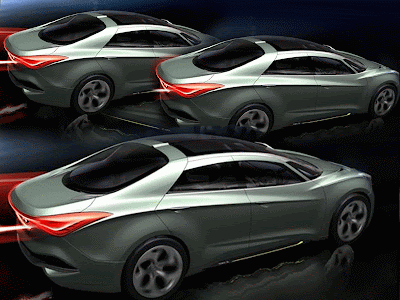
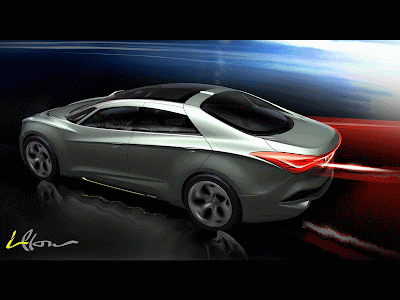
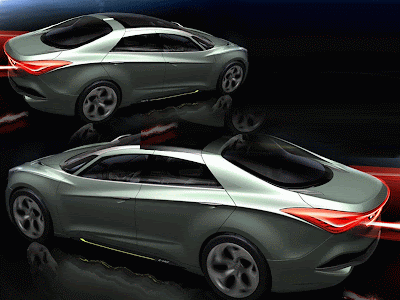
The Geneva Motor Show is quite generous in reveals this year, considering the trend of the automotive industry. Hyundai has just presented its new i-Flow Concept on the catwalk, continuing the company’s statement of developing a the “fluidic design”. As Hyundai continues to branch out into new segments, its European operation, which until recently has focused primarily on small cars, is debuting the Hyundai i-flow concept in Geneva. It's a vision of a coming Hyundai that's expected to do battle in Europe's larger D-segment.
2010 Hyundai i-Flow Concept Diesel-Electric Hybrid Powertrain
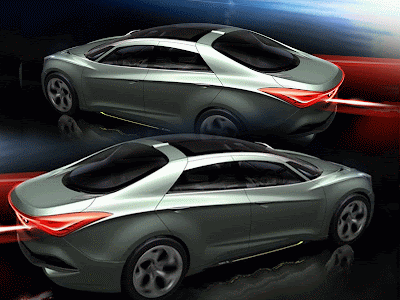
The i-flow is the latest concept to wear Hyundai's "fluidic sculpture" design language, and the large D-segment sedan wears it well. Hailing from Hyundai's European Design Headquarters in Russelsheim, Germany, the i-flow incorporates lightweight materials and solar cells from supplier BASF meant to reduce weight and increase energy efficiency.
2010 Hyundai i-Flow Concept Diesel-Electric Hybrid Powertrain
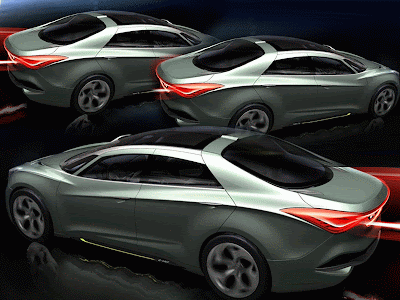
The i-flow is fitted with Hyundai's first-ever diesel hybrid drivetrain, in which a 1.7-liter diesel engine with dual-stage turbocharging is mated to Hyundai's Blue Drive hybrid system and a new six-speed dual-clutch gearbox. As we understand it, the i-flow is a parallel hybrid, allowing it to be powered by its lithium-polymer battery pack and electric motors, the diesel engine or a combination of both. Combined with a slippery 0.25 coefficient of drag, the i-flow will reportedly return 78.4 mpg and emit 0.30 grams of CO2 per mile.
2010 Hyundai i-Flow Concept Diesel-Electric Hybrid Powertrain
The new lines give an elegant avant-garde look, helping in the same time in reducing the CO2 emissions to 85g/km and improving its aerodynamics. In collaboration with chemical company BASF, Hyundai produced its first eco-friendly diesel hybrid powertrain, using high-technologies and next-generation materials. The new i-Flow combines perfectly the concept of a little-big car, as it shows a sporty looks but also provides quite enough space due to the use of a minimalistic design for the seats and center console.
2010 Hyundai i-Flow Concept Diesel-Electric Hybrid Powertrain
The high-tech engine presents the new 1.7-litre engine fitted with 2-stage turbocharging connected to a Lithium Ion-Polymer battery for a more efficient consumption, especially when driven i-flow’s six-speed, dual-clutch transmission. The i-Flow technology is a test bed for new energy harvesting ideas, ranging from flexible solar panel roofing to a thermo-electric generator which uses exhaust heat to produce power. More news of Hyundai’s star cars will be published in advance of the show and will be available on the stand. The company’s press conference will take place in Hall 1 at 14:15 (CET) on Tuesday 2nd March (2010).
Thursday, March 11, 2010


Hyundai is a group of companies founded by Chung Ju-yung in South Korea. The first Hyundai company was founded in 1947 as a construction company, and eventually became South Korea's largest conglomerate company (Jaebeol).
Some of the best-known Hyundai divisions are Hyundai Motor Company - the world's 4th largest automaker[1] and one of the The Asian Four (with Toyota, Honda and Nissan), Hyundai Heavy Industries - the world's largest shipbuilder, and Hynix - a top semiconductor manufacturer. Other companies currently or formerly controlled by members of Chung's extended family may be loosely referred to as a part of the Hyundai chaebol.
Hyundai Group underwent a massive restructuring following the 1997 East Asian financial crisis and the founder's death in 2001. Today many companies bearing the name Hyundai are legally unrelated to the Hyundai Group. Some of the larger former members of the conglomerate include Hyundai Group, Hyundai Kia Automotive Group, Hyundai Department Store Group, Hyundai Heavy Industries Group, and Hyundai Development Group. Following the conception, Hyundai Group's business remains manufacturing of elevators, fung chu tin, container shipping services, and tourism.
 hyundai
 hyundai
 hyundai
 hyundai
Hyundai Car Photos

Hyundai Car Wallpapers

Hyundai

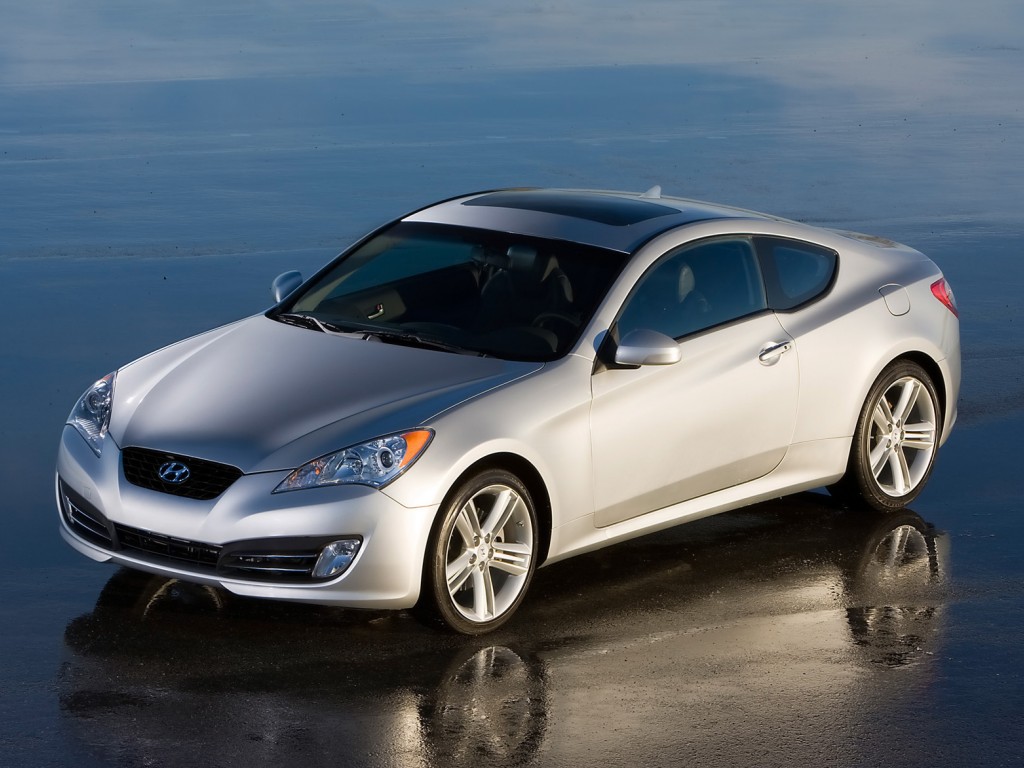
Hyundai Genesis Coupe

Hyundai Genesis Coupe Picture

Hyundai Genesis Coupe wallpaper

Hyundai Genesis Coupe

hyundai

hyundai

hyundai

hyundai

hyundai
Sunday, December 27, 2009
2010 Hyundai Genesis Sports Car Coupe with SHIFTRONIC to handle the additional torque
0 comments Posted by Qcist at 9:26 AM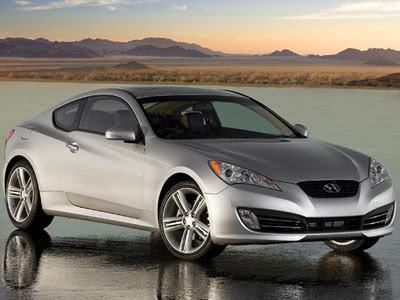 2010 Hyundai Genesis Sports Car Coupe
The people at South Korean automaker Hyundai are listening to their customers. The 2010 Hyundai Genesis Coupe, confirmed for production and a release early in 2009, follows the tradition of the 2009 Hyundai Genesis in offering a true high performance rear wheel drive, sporty architecture in an affordable package. The 2010 Genesis Coupe is a purpose-built rear-wheel drive sports coupe featuring two performance-focused engines - a212-horsepower 2.0-liter turbocharged four-cylinder engine and a range-topping all-aluminum 306-horsepower, DOHC 3.8-liter V6 engine.
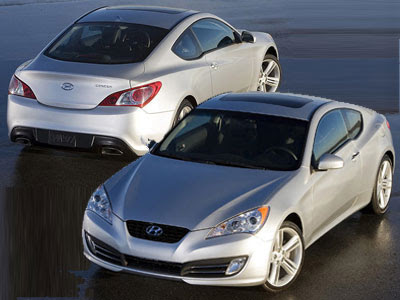 2010 Hyundai Genesis Sports Car Coupe
Genesis Coupe employs a MacPherson strut dual-link front suspension and a five-link rear suspension setup. Both engines are mated to a standard six-speed manual transmission. The Genesis Coupe 2.0t (2.0-liter 4-cylinder turbo) offers an optional five-speed automatic with SHIFTRONIC® while the 3.8-liter V6 offers a ZF six-speed automatic transmission with SHIFTRONIC to handle the additional torque.
The Genesis Coupe follows the styling tradition set forth by the Hyundai Tiburon, but outdoes that aging Hyundai compact sports car in every way. The Genesis Coupe comes with an available naturally aspirated V6, sure to be a motor to find its way into more of Hyundai's lineup. The high output engine offers 310 horses on premium fuel. Following the introduction earlier this year of the rear-wheel drive Genesis sport sedan, Hyundai Genesis Coupe is Hyundai's most dynamic performance car ever and the second consecutive all-new model introduction from Hyundai appealing directly to the car enthusiast.
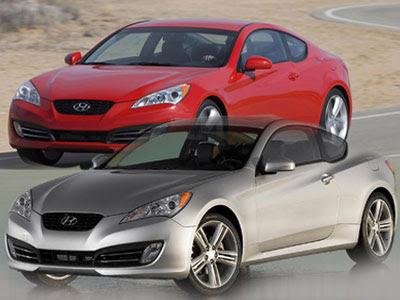 2010 Hyundai Genesis Sports Car Coupe
Hyundai Genesis Coupe uses the same flexible rear-wheel drive architecture originally developed for the Genesis sport sedan.
The 2010 Hyundai Genesis Coupe offers Xenon high-intensity discharge (HID) headlights. The advantages of HID headlamps include greater lighting power, daylight-type lighting and reduced power consumption. In addition, the cut lines of the new HID headlights are extremely precise, providing maximum nighttime visibility without distracting other drivers.
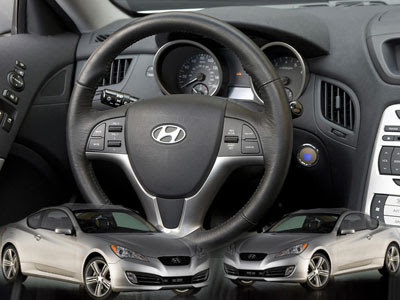 2010 Hyundai Genesis Sports Car Coupe
 2010 Hyundai Genesis Sports Car Coupe
The Hyundai Genesis Coupe is offered in three trim levels: the stylish and affordable GS, the premium-sport GT featuring the 3.8-liter V6, and the high-performance SE, available with either the 2.0-liter turbocharged four-cylinder engine or the 3.8-liter V6 engine.
 2010 Hyundai Genesis Sports Car Coupe
Hyundai Genesis Coupe uses the same flexible rear-wheel drive architecture originally developed for the Genesis sport sedan.
The 2010 Hyundai Genesis Coupe offers Xenon high-intensity discharge (HID) headlights. The advantages of HID headlamps include greater lighting power, daylight-type lighting and reduced power consumption. In addition, the cut lines of the new HID headlights are extremely precise, providing maximum nighttime visibility without distracting other drivers.
All Hyundai Genesis Coupe models feature standard four-channel ABS with Electronic Brake-force Distribution (EBD) to optimize brake performance under various dynamic loading conditions. The system also includes Brake Assist, which provides maximum ABS-level braking force when a panic stop is detected.
 2010 Hyundai Genesis Sports Car Coupe
It is nice to see that Hyundai, an automaker currently enjoying growth and a solid reputation for producing mainstream-market cars that last, is making steps toward the sports car market. The styling of the Genesis Coupe is hit or miss, some will love it and others will wonder what Hyundai was thinking. But, with the sports car pedigree to back it up, the Genesis Coupe should be another worldwide hit for Hyundai.
 2010 Hyundai Genesis Sports Car Coupe
The Hyundai Genesis Coupe is offered in three trim levels: the stylish and affordable GS, the premium-sport GT featuring the 3.8-liter V6, and the high-performance SE, available with either the 2.0-liter turbocharged four-cylinder engine or the 3.8-liter V6 engine.
Subscribe to:
Posts (Atom)


