


|
|
|---|


Monday, January 25, 2010
 Modern design Aptera futuristic concept car with image 1
 Modern design Aptera futuristic concept car with image 2
 Modern design Aptera futuristic concept car with image 3
 Modern design Aptera futuristic concept car with image 4
 Modern design Aptera futuristic concept car with image 5
Sunday, January 24, 2010
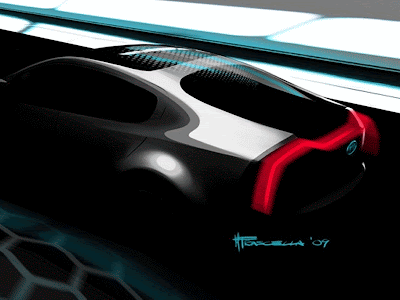
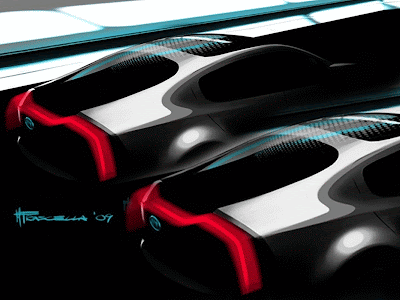
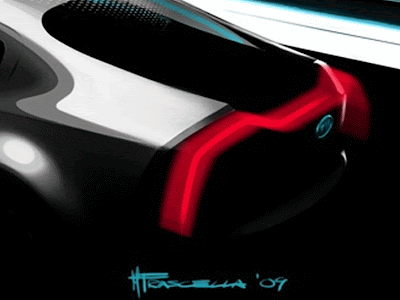
Kia Ray designed at Kia's American design studios released only in an illustration. There's no other details about this vehicle and it seems we must wait until the Chicago Auto Show going to get any further to what is really shown by Kia through Ray Plug-in hybrid it.

 G-Power, specializing in tuning of BMW cars, unveiled its new masterpiece - a revised X5.
The same compressor eight engine was capable of delivering 625 hp. Maximum speed cars increased to 300 km / h. In order to improve optical performance and aerodynamics, experts have prepared G-Power for the BMW X5 bodikit Typhoon Black Pearl. In the package of improvements included: the modified wheel arches, increased mud and spoilers front and rear. The car became the owner of a unique carbon fiber hood from unvarnished. The slots on the hood provide fast outflow of hot air. Power X5 significantly increased (to 270 hp and torque to 225 Nm) through the compressor system SK III RS, specially developed in the studio. Step up to the first "hundreds" took 4.5 seconds, and already after 16 seconds the speed of developing up to 200 km / h. Black Pearl - a name given BMW X5 tuners studio.

Summer - season convertibles. And just for the season should see a nonstandard cabrio - based on the crossover Nissan Murano.
Japanese company has confirmed its intentions during the Auto Show in Detroit. According to preliminary information, Murano convertible will be equipped with a soft folding roof. Under the hood will be 3.5-liter V8 engine power of 265 hp
Nissan Murano Convertible is a limited edition. Price is not reported.
Saturday, January 23, 2010
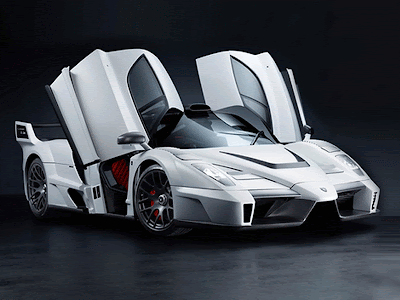
Now, the company manager from Leonberg near Stuttgart takes on a new challenge. The automobile manufacturer turns the most potent super sports car from Maranello, the Ferrari Enzo, into the GEMBALLA MIG-U1 - an individually produced edition, limited to only 25 cars. In the last 27 years, Uwe Gemballa has achieved the best world-wide reputation for refining Porsche cars. The core part of the overall makeover is the entirely re-engineered aerodynamics concept by GEMBALLA. Without any exception, the manufacturer produces all components in real carbon in order to combine lowest weight with highest material strength.
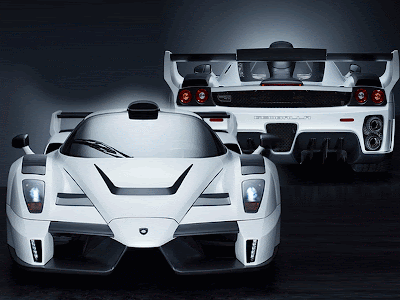
Owing to the active aerodynamics conception, the front spoiler lip generates an additional downthrust of up to 35 kilograms at the front axle, according to the individual position. Analogically, the flap on the newly designed rear spoiler generates even up to 85 kilograms more downthrust on the rear wheels. For optimal handling results, the flap lowers, as soon as the car reaches a speed of 120 km/h. In this way, the GEMBALLA-aerodynamics concept adjusts to the outer conditions and always ensures perfect road holding characteristics. All components of the aerodynamics kit attribute to this: starting from the new front skirt with spoiler lip, over the door extensions to the diffuser and rear spoiler.
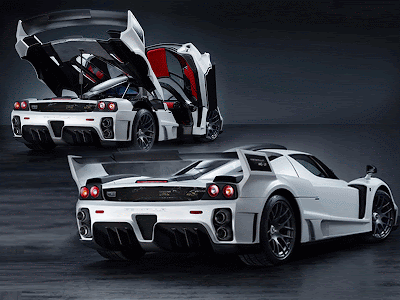
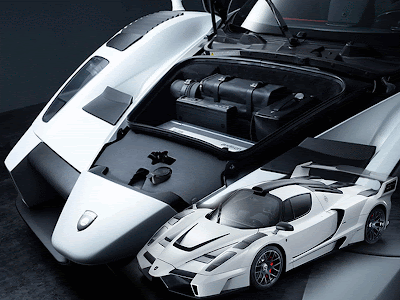
The air duct system of the GEMBALLA MIG-U1 does not only help bringing the power of the twelve-cylinder car onto the road. At the same time, the engineers from Leonberg (Baden-Wurttemberg) develop an extensive ventilation- and cooling concept. Here, both the front and the back wheel-houses are supplied with cooling air and this guarantees an optimal use of the high performance braking system. The GEMBALLA car body components therefore guarantee the functionality of the new super sports car and provide the car with a unique look at the same time. Following the design of Formula-1 racing cars, the GEMBALLA MIG-U1 has an extended front and an edged rear spoiler. Formerly rounded edges were replaced in order to provide the car with an aggressive look with greedy air inlets and outlets.
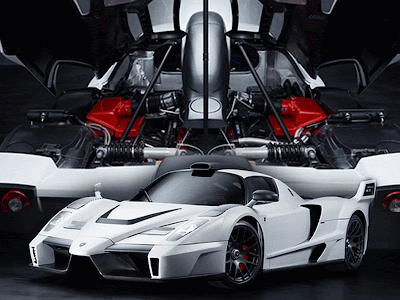
The twelve cylinder engine of the GEMBALLA MIG-U1 works with an optimised motor management and an especially adjusted exhaust system. This combination allows a performance output of 700 hp (515 kW). The four-pipe system with pneumatic flap control is added to the sports catalyser. The end-pipes are equipped with the typical GEMBALLA heat shield and share the exit into the rear skirt with the exhaust ducts of the rear wheel houses.
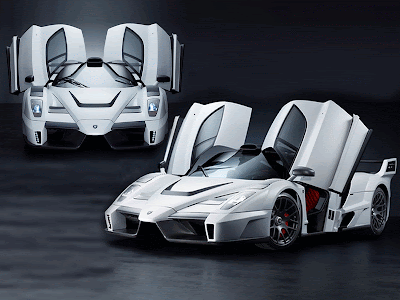
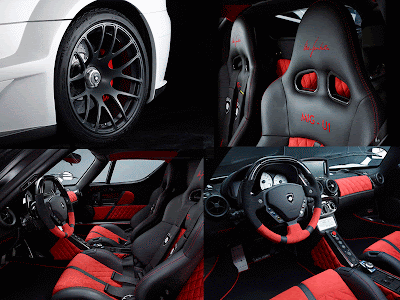
In the interior, GEMBALLA devises a control centre which perfectly combines functionality and comfort. The especially for the GEMBALLA MIG-U1 designed seats, the custom-made centre console and the sports steering wheel with its leather-ultra suede combination guarantee full control over the car. At the same time,
the interior of this super sports car reflects pure luxury.
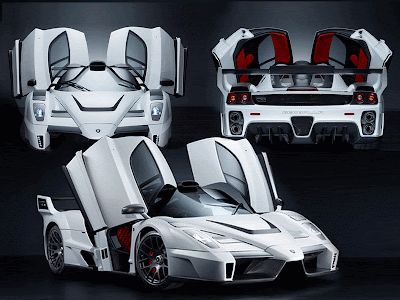
With the GEMBALLA MIG-U1, the automobile manufacturer once again proves that its know-how is not only limited to Porsche cars. On the basis of the already exhilarating Ferrari Enzo, the engineers developed a unique car. But even the limited edition with only 25 cars is not exclusive enough for GEMBALLA. Therefore, every single GEMBALLA MIG-U1 is individually adjusted. This ensures that there will not be any identical cars. Therefore, the specialist with its reputation for unique high-end refinement once again meets the requirements for highest individuality.
Friday, January 22, 2010
Modern Design F-Cell Roadster Hybrid Mercedes-Benz Concept Car
0 comments Posted by Qcist at 5:35 AM Modern Design F-Cell Roadster Hybrid Mercedes-Benz Concept Car
Mercedes-Benz has been toying with alternative-energy prototype vehicles for awhile now, the obviously conceptual F-CELL Roadster hearkens back to M-B vehicles of old, though the engine is far from retro.
 Simple Modern Design F-Cell Roadster Hybrid Mercedes-Benz Concept Car
 Design Interior F-Cell Roadster Hybrid Mercedes-Benz Concept Car
 Cool Design F-Cell Roadster Hybrid Mercedes-Benz Concept Car
The F-CELL Roadster built by apprentices at the Mercedes-Benz plant in Sindelfingen covered a section of the historic route taken by Bertha Benz on the past weekend. Starting in Mannheim, the fuel cell powered car was driven via Ladenburg and Heidelberg. The symbolic passing of the finish line was at the chemist’s shop in Wiesloch, where Bertha Benz stopped to refuel during the first long-distance journey in automobile history in 1888. “This trip by the F-CELL Roadster is symbolic of the current change taking place in automobile engineering”, says Dr. Thomas Weber. “At that time Bertha Benz was not yet able to purchase the petrol she needed at a filling station, and for emission-free mobility we are also dependent on the widespread distribution of fuels for the future – electric power and hydrogen. But just as Bertha Benz refused to be discouraged by inconveniences in her day, we are just as determined to help ensure that these technologies achieve their breakthrough.” Before the end of this year, Mercedes-Benz will commence small-series production of the B-Class with a fuel cell drive system. At the end of 2009 the first examples of the smart fortwo electric drive model will also leave the production line to enter service in the “e-mobility Berlin” project early next year.
 Cool Design F-Cell Roadster Hybrid Mercedes-Benz Concept Car
Developed by 150 trainees of Daimler AG at the Sindelfingen Mercedes-Benz plant, the F-Cell Roadster is being claimed as a unique blend of art and technology. As an allusion to the Benz Patent Motor Car from the late 1880s, the car is fitted with a hybrid drivetrain and spoked wheels.
Powered by a 1.2KW hybrid drive, the car is capable of hitting a top speed of 15 mph and an operating range in excess of 210 miles. Of course the car won’t be the fastest to get off the blocks, but the design and the features do display the feasibility of tweaked historic cars in today’s modern era.
 F-Cell Roadster Hybrid Mercedes-Benz Concept Car with Gallery Picture
 Nice F-Cell Roadster Hybrid Mercedes-Benz Concept Car
The F-CELL Roadster uniquely combines state-of-the-art technologies with the history of vehicle construction. As an allusion to the Benz Patent Motor Car from 1886, the vehicle is fitted with large spoked wheels. Moreover, the F-CELL Roadster incorporates stylistic elements from diverse eras of automotive history, such as the carbon-fiber bucket seats with hand-stitched leather covers and the distinctively styled fiberglass front section, based on the component from the Formula One racing bolides. The F-CELL Roadster is controlled with drive-by-wire technology, and a joystick takes the place of a conventional steering wheel. The vehicle is powered by the emission-free fuel cell system located at the rear. With a power rating of 1.2 kW the F-CELL Roadster reaches a top speed of 25 km/h and has an operating range of up to 350 km.
 Simple Design Futuristic Naro and Clever Concept Car
The British company Prodrive envisioned a new concept for a vehicle with an enclosed body and the width of a motorcycle. Its concept Naro however has four wheels and works with a tilting mechanism to prevent it from tipping over in curves in the road.
 Beauty Naro Design Futuristic Naro and Clever Concept Car
Naro: "NARROW CITY VEHICLE" is a city vehicle designed to diminish the traffic congestion and pollution in urban areas. With its narrow body, the four-wheeled Naro is able to drive through traffic congestions much in the same way as a motorcycle. The two passengers sit behind one and another in the fully enclosed body, which offers a passive safety level comparable to a small modern passenger car. The front-positioned driver however sits higher above ground level and therefore has a better view over the road.
 Cool Design Futuristic Naro and Clever Concept Car
A conventional four-wheeled vehicle with a similar narrow track and high centre of gravity would tend to fall over sideways when turning at high speeds. To avoid this problem, the Naro is equipped with a carving mechanism which makes all four wheels and the body tilt sideways during cornering. The amount of tilt during cornering depends on the driving speed.
 Modern Design Futuristic Naro and Clever Concept Car with Yellow Color
 Prodrive envisions various applications for the Naro, including a passenger vehicle, city taxi and delivery vehicle. The company has completed a first prototype and is conducting road-tests during 2006.
 Amazing Design Futuristic Naro and Clever Concept Car
Another enclosed motorcycle concept is in development by a European consortium, on initiative of the Technical University in Berlin, Institute for Motor Vehicles. This three-wheeled vehicle, named CLEVER (Compact Low Emission Vehicle for Urban Transport), is designed as a city vehicle for two people, which requires little space, has a low weight, a low fuel consumption and low emissions.
 Simple Design Naro and Clever Concept Car
The CLEVER (Compact Low Emission Vehicle for Urban Transport) is a compact city vehicle for two people, which requires little space and has a low weight. In turn, the vehicle requires just a small engine in order to reduce fuel consumption and exhaust emissions. The CLEVER is under development by a European consortium, on initiative of the Technical University in Berlin, Institute for Motor Vehicles. In 2006 a prototype vehicle was built by the University of Bath in Great Britain.
 Design Futuristic Naro and Clever Concept Car
TECHNICAL SPECIFICATIONS:
DRIVE SYSTEM:
Direct drive with single-cylinder 230 cc engine
POWER OUTPUT: 12.5 kW (17 hp) @ 8,600 rpm
FUEL: Natural gas
FUEL CONSUMPTION: 2.4 l / 100 km (98 mpg US)
ACCELERATION 0 – 60 KM/H (37 MPH): 7.0 sec.
MAXIMUM SPEED: 100 km/h (62 mph)


